An AI sales solution only creates real value when it is deployed in real conversations, encounters real sales situations, and delivers measurable results.
That is also how AIBUS develops AZbot.
Instead of building a complete product based on the assumption that every shop sells in the same way, AIBUS deploys AZbot into specific business models, observes how customers ask questions, how sales staff provide consultation, and which problems are reducing sales efficiency on Facebook.
From household appliances and fashion to cosmetics and accessories, each industry presents a different challenge. These real-world situations have helped AIBUS gradually develop AZbot from a conversation support system into an AI Sales Employee capable of participating more deeply in consultation and order creation.
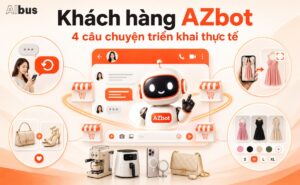
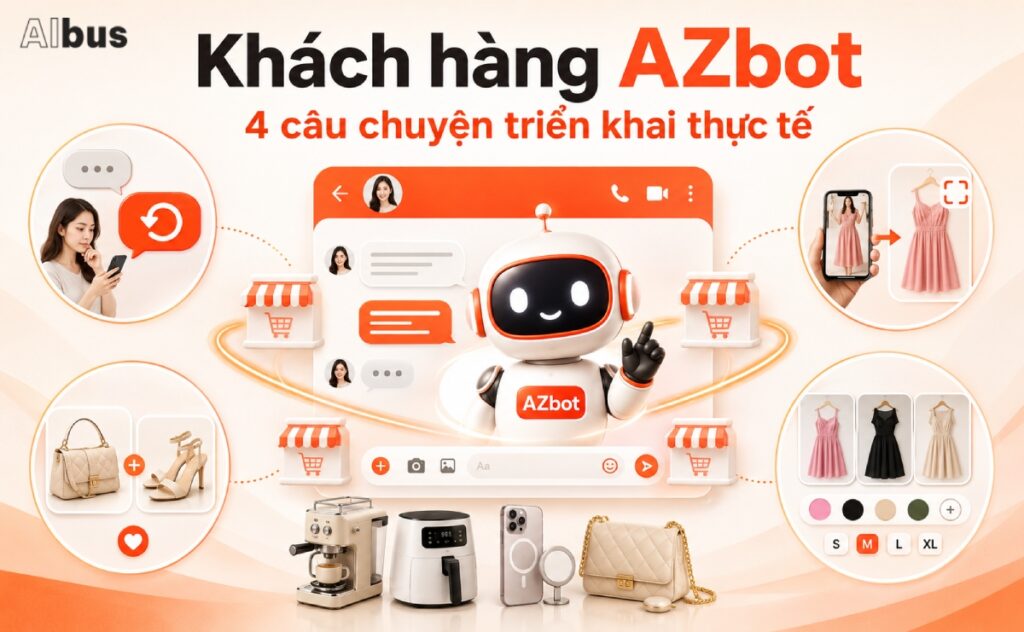
Real stories from AZbot customers
Each shop comes to AZbot with a different context.
AIBUS does not apply the same sales script to every business. Deployment begins with understanding each shop’s specific problems, then configuring AZbot based on its actual data and sales process.
A household appliance shop and forgotten conversations
A shop selling household appliances and kitchen equipment was the first customer to use AZbot for selling on Facebook.
After operating for some time, the shop noticed that many customers had asked detailed questions about products but stopped the conversation before placing an order. As conversation volume increased, staff could no longer remember to follow up with every potential customer.
- Around 28% of customers stopped before placing an order
- Approximately 2,100 potential customers per month needed follow-up
- Staff were only able to follow up with 20–25% of them
AIBUS worked with the shop to identify which conversation states still had sales potential, when customers should be contacted again, and what follow-up content would be appropriate based on previous discussions.
From this, AZbot was developed with the ability to follow up with customers based on conversation context, rather than sending the same generic message to everyone who had not yet purchased.
After one month of deployment, the shop recorded positive results:
- 31% of followed-up customers returned to the conversation
- 14% of followed-up customers later placed an order
- Approximately 290 additional orders per month were generated
An accessories shop wanted AZbot to recommend relevant additional products
While working with KJS, a shop specializing in phone and computer accessories, AIBUS encountered another set of challenges:
- Many products have clear cross-selling relationships
- Upselling and cross-selling opportunities depended heavily on each salesperson’s experience
AIBUS worked with the shop to identify product groups that were commonly purchased together and the right moments to make additional recommendations.
AZbot was then refined to suggest complementary products only when they were genuinely relevant to the customer’s current needs, rather than making recommendations mechanically.
The shop achieved the following results:
- The percentage of orders containing cross-sold products increased from 18% to 32%
- Average products per order increased from 1.21 to 1.38
- Average order value increased by 12%
- Additional revenue generated from cross-selling reached approximately VND 85 million per month
A fashion shop needed AZbot to understand customer-submitted images
QT, a shop selling women’s fashion with a wide range of tops, dresses, and pants, encountered a very common situation in Facebook sales.
Instead of asking for a product by name, many customers simply sent a photo and asked: “Is this item still available?”
For a human salesperson, identifying a product from an image is straightforward. But if AZbot could not recognize which product the customer was referring to, the conversation had to be transferred to a human almost immediately.
Based on these real conversations, AIBUS developed AZbot’s ability to recognize products from images and connect them with the shop’s data.
Once the product is identified, the system can continue providing consultation for the exact item shown in the image. Images that are unclear or cannot be identified with sufficient confidence are still transferred to a human employee.
After image recognition was introduced, fewer conversations needed to be handed over to staff at the beginning of the interaction. Within just one week, the number of conversations AZbot could continue handling automatically increased by approximately 24%.
A fashion shop with a diverse product catalog
The same QT fashion shop initially focused on selling only one main product, and everything worked smoothly. As the shop expanded its catalog, AIBUS noticed a situation occurring more frequently than expected: customers rarely ask about just one item and immediately make a purchase.
The challenges the shop faced
- The shop carries many tops, pants, and dresses
- Each product comes in different sizes and colors
- Customers often return to products mentioned many messages earlier
- A single order may contain multiple products, sizes, and colors
If AZbot only focused on the product mentioned in the most recent message, the system could easily confuse products, variants, or lose information discussed earlier in the conversation.
AIBUS therefore developed AZbot to maintain multiple products within the same sales context.
The system keeps track of which products the customer has asked about, which product is currently being discussed, and the corresponding size and color for each option. When a customer returns to a product mentioned earlier, AZbot can continue the consultation from the correct context instead of starting over.
After multi-product capabilities were introduced:
- 82% of conversations were completed without human intervention
- 27% of orders created by AZbot contained two or more products
- Average products per order increased by 18%
- Average order value increased by 14%
Customer requirements have expanded AZbot’s capabilities
These four stories began with four very specific operational needs:
- Continue engaging customers who had asked questions but had not yet purchased
- Capture more cross-selling opportunities
- Understand images sent by customers
- Handle multiple products within the same conversation
Capabilities such as follow-up, cross-selling, image recognition, and multi-product handling therefore did not emerge only from a predefined feature roadmap.
They were shaped by real problems AIBUS encountered after AZbot had already become part of the sales process.
This is also how AIBUS continues to develop AZbot toward the AI Sales Employee model: start with real problems faced by online sellers, deploy a solution, observe the results, and continue improving it.