Some products are developed from carefully perfected designs, while others are shaped by real-world problems. AZbot was not built by AIBUS with the goal of completing every possible feature before bringing it to market.
From the beginning, AIBUS chose a different approach: identify a clearly defined sales problem, build a version capable of solving it, deploy it in real-world use, and continue developing the product based on market feedback.
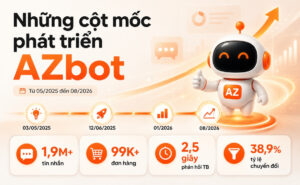
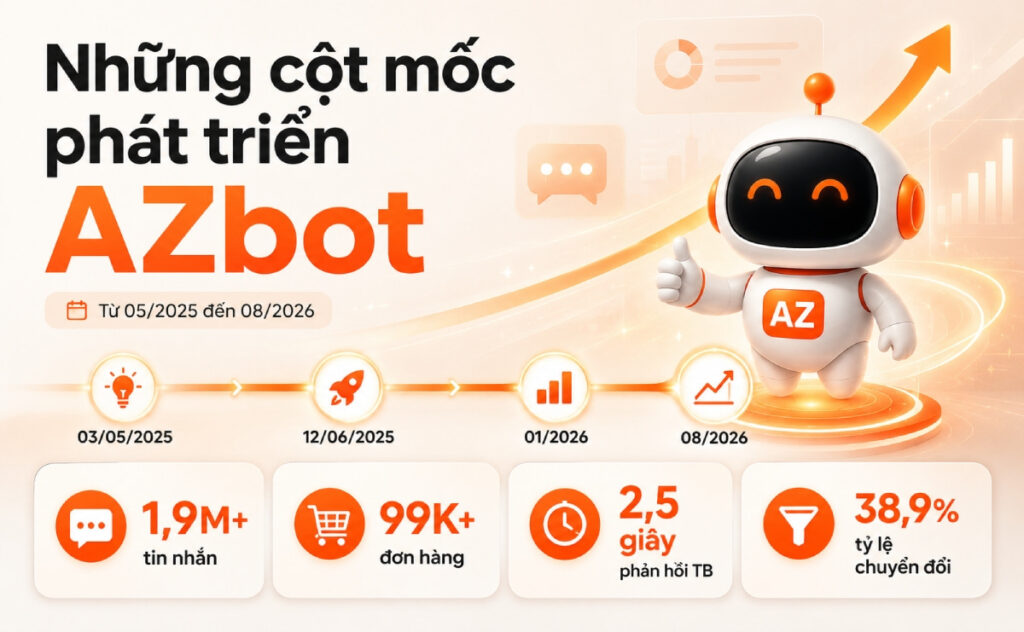
May 3, 2025 — AIBUS began developing AZbot
AZbot started with a specific question: how could AI participate in the online sales process, especially for shops that regularly handle a large volume of customer conversations?
Instead of immediately trying to build an AI system capable of performing every task of a salesperson, AIBUS narrowed the scope and focused first on the most urgent needs.
The first version needed to work with each business’s own data, handle customer conversations, and support real-world sales scenarios.
“For AIBUS, an AI product does not necessarily need to be perfect before it reaches users. What matters more is that it solves a clearly defined problem well enough to be deployed in the real world and begin being validated.”
June 12, 2025 — The first version was released
After just over one month of development, the first version of AZbot was officially launched.
This became one of the milestones that shaped how AIBUS would continue developing the product.
Instead of spending many months building a long list of features based on assumptions about market demand, the team chose to release the product as soon as the initial problem had been solved well enough for real-world operation.
From that point forward, the question was no longer how many more features could be added to AZbot, but rather what real users needed the product to solve next.
Only about three days after marketing activities began, AZbot acquired its first customer, a household appliance retailer.
This was also the first time the product had to handle real sales conversations, including questions about products, functionality, customer needs, and situations that were difficult to predict during development.
After the first month of deployment, the shop recorded several positive changes:
- Average response time decreased by 91%
- The number of conversations handled increased by 25%
- Conversion rate increased from 15% to approximately 24%
- The number of orders increased by approximately 41%
Early January 2026 — AZbot reached 5.3 million messages
After approximately six months of operation, the total number of messages handled by AZbot reached 5.3 million in early January 2026.
From a growth perspective alone, this was already a notable figure. For the AIBUS team, however, the greater value came from the volume of real-world business situations the system had experienced.
Millions of messages demonstrated just how many different ways customers could ask questions. A sales conversation rarely follows a fixed script.
This real-world data helped AIBUS better understand the limitations of a chatbot focused only on answering questions. As a result, AZbot gradually evolved toward understanding customer needs, recommending products, and participating more deeply in the sales process rather than simply responding to messages.
From millions of conversations to operating across multiple industries
Starting with its first customer in the household appliance industry, AZbot gradually expanded into a wider range of sectors, including fashion, cosmetics, food, accessories, and others.
Each industry introduced different requirements for AI:
- In household appliances, customers often ask about functionality, specifications, intended use, warranties, and return policies.
- In fashion, conversations frequently involve sizes, colors, designs, and inventory availability.
- In cosmetics, AI needs to handle more detailed questions about skincare needs, ingredients, and product usage.
- In accessories, the system often needs to identify the product a customer is currently using before recommending compatible options.
This diversity meant that AIBUS could not develop AZbot around a single sales script for every business.
At the same time, many new capabilities were added in response to needs that emerged during real-world deployment.
AZbot began providing stronger support for selling multiple products within the same conversation, remembering what customers had previously discussed and maintaining context as they moved from one product to another.
Cross-selling capabilities were also developed so that AI could not only handle the product a customer was asking about, but also identify opportunities to recommend relevant complementary products.
Another major development was image recognition. Customers may send photos of products or specific models, and AI can process this visual information, making the conversation closer to how a human salesperson would work.
Other capabilities were also introduced, including follow-ups, transferring conversations to human employees, and working with each business’s proprietary data.
These features were not added simply because AIBUS wanted AZbot to include more technology. Most of them originated from specific situations encountered by customers during actual deployment.
August 2026 — AZbot reached a new level of operational scale
By August 2026, AZbot’s monthly operational metrics showed that the product had entered a new stage of scale:
- More than 1.9 million messages
- Nearly 100,000 orders
- Average response time of 2.5 seconds
- Conversion rate of 38.9%
If the first 5.3 million messages gave AIBUS a large dataset from which to learn about the market, the current operational metrics introduced a new challenge: how to ensure that AI continues to respond quickly, operate reliably, and maintain quality as conversation volume continues to grow.
Handling 1.9 million messages per month reflects the system’s operational scale. More than 99,000 orders show that AI is now directly contributing to business outcomes rather than simply answering customer questions.
Each milestone changed how AIBUS develops AI products
Looking back at the journey from May 2025 to the present, AZbot’s development can be seen across several different stages.
At first, AIBUS focused on solving a specific problem and bringing the product to market quickly.
Once the first customers began using the product, development became increasingly driven by real-world needs and feedback.
As interaction volume grew into the millions, data became an important source for improving the AI’s capabilities.
As the product expanded across multiple industries and began serving a much larger customer base, the challenge shifted toward adaptability, business effectiveness, and operating reliably at scale.
This is also how AIBUS continues to develop AI products: start with a real-world problem, deploy a solution, observe what happens, learn from the data, and continue improving.
AZbot is still evolving. The milestones reached so far are not the end of the journey, but a foundation for AIBUS to continue bringing AI deeper into sales and other real-world business processes.